
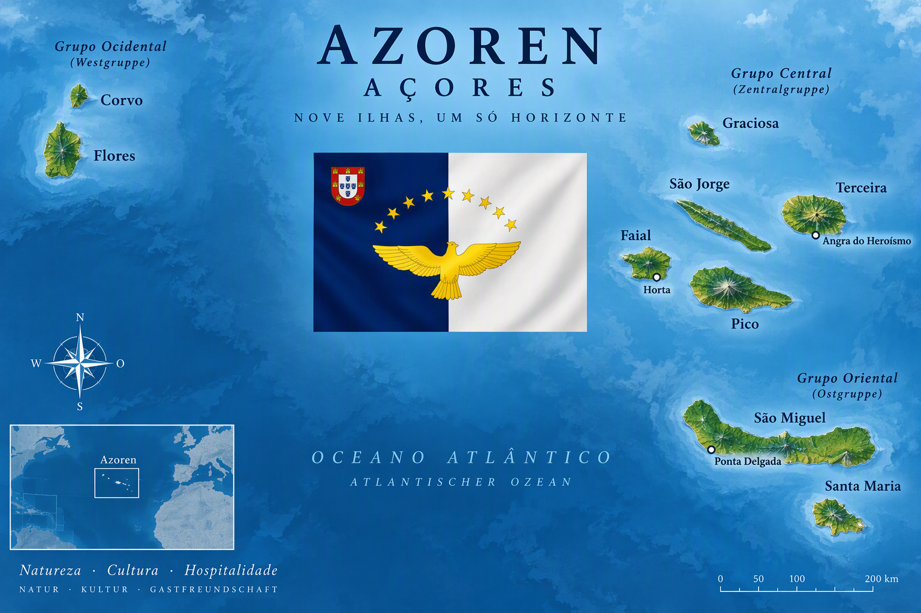
AZORES – travel planning
Whitsun 2027 – Azores Itinerary
Information about São Miguel Island
Information about the island of São Jorge
Information about the island of Faial
Tuesday, 18 May 2027
OUTBOUND JOURNEY Booking reference: 7TRA3D
Departure from: Nuremberg (NUE) – Date: 18 May 2027 – Time: 11:10
Flight number: LH 143 – Operated by: Lufthansa
Total journey time: 0h 50m
Arrival at: Frankfurt International (FRA) – Date: 18 May 2027 – Time: 12:00
1 stopover at Frankfurt International: 1h 15m
Departure from: Frankfurt International (FRA) – Date: 18 May 2027 – Time: 13:15
Flight number: LH 1168 – Operated by: Lufthansa
Total journey time: 3h 15m
Arrival at: Lisbon (LIS) – Date: 18 May 2027 – Time: 15:30
1 stop in Lisbon 1h 35m
Departure from: Lisbon (LIS) – Date: 18 May 2027 – Time: 17:05
Flight number: LH 6100 – Operated by: TAP Air Portugal on behalf of Lufthansa
Total journey time: 2h 30m
Arrival at: Nordela Airport (PDL) – Date: 18 May 2027 – Time: 18:35
Car hire Collection – booked via check24.de – Hire company: Micauto – +351296684632
Hire period: Tue, 18 May 2027, 19:00 to 21 May 2027, 07:00
Autatlantis Reference: 403119 – Micauto / BSP Auto – Reference: 522816030345
Car Group: JFMD (O) – Jeep Renegade or similar – Air conditioning – 5 doors – 5 seats
Emergency hotline: +49 (89) 2424 1142 3140389 from 19 May to 25 May.
Accommodation at
Hotel Do Colegio, Rua Carvalho Araujo 39, Ponta Delgada, 9500-040, Telephone: +351 296 306 600
two double or twin rooms including breakfast
Activities after arrival:
perhaps a short stroll through the old town or down to the harbour
Dinner suggestions:
• Taberna Açor (R. dos Mercadores 41), authentic, cosy
• Louvre Michaelense (R. António José D’Almeida 8) – craft beer!
• Cais 20 (2ª, Bairro do Terreiro 9 11, São Roque) – fish & seafood right by the water
• O Silva (R. Direita de Cima 41 in Ribeira Grande) – fish, reportedly very good
• Caldeiras & Vulcões (R. Das Caldeiras 36, Furnas) – Cozido & local cuisine
 Wednesday, 19 May 2027
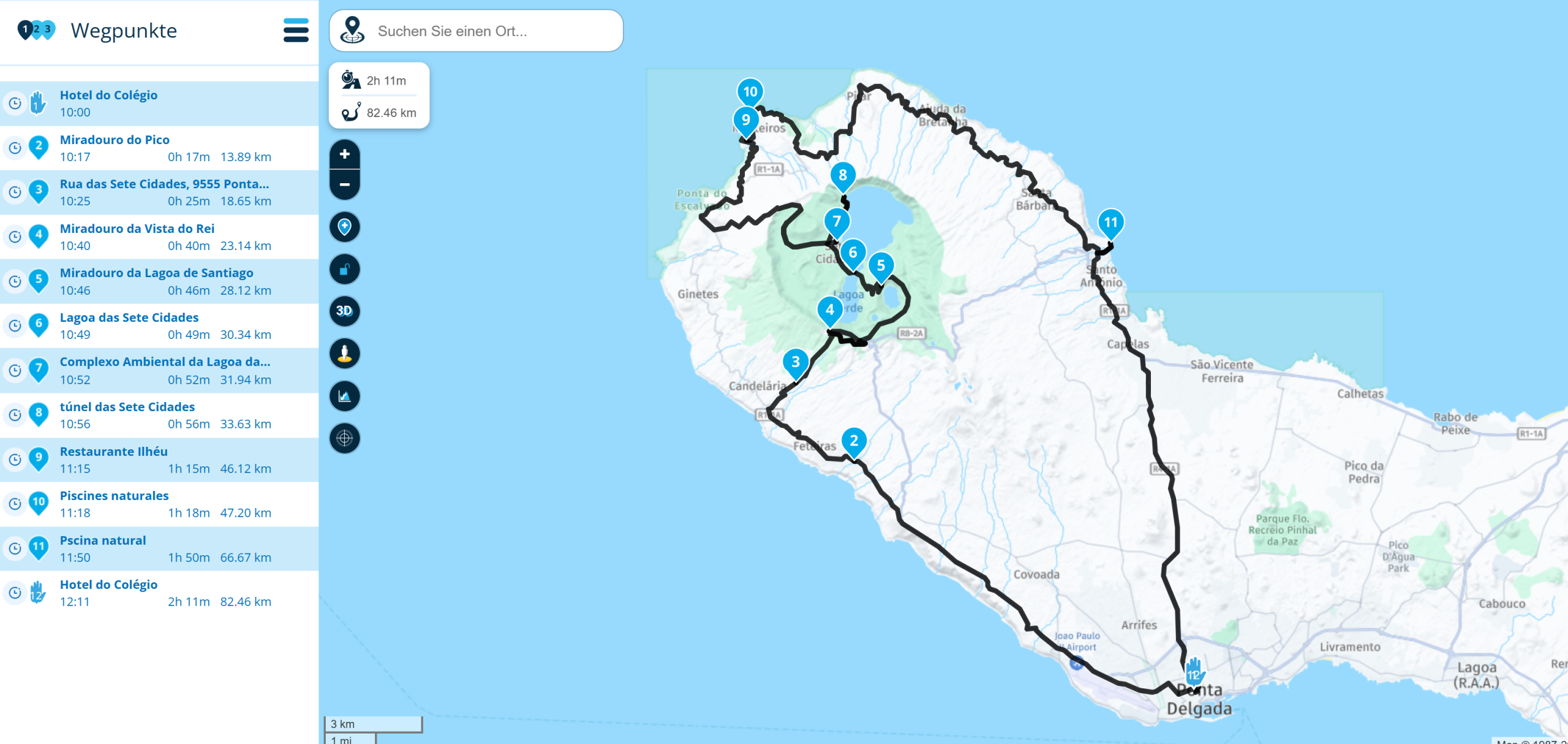
Circular tour from Lagoa do Azul to the west coast and back via the north-west coast
- Hotel do Colégio
- Miradouro do Pico
- Rua das Sete Cidades, 9555 Ponta Delgada, Portugal
- Miradouro da Vista do Rei
- Miradouro da Lagoa de Santiago
- Lagoa das Sete Cidades
- Complexo Ambiental da Lagoa das Sete Cidades, Rua Atlanti
- Sete Cidades Tunnel
- Ilhéu Restaurant
- Natural pools
- Natural pool
- Hotel do Colégio
 Thursday, 20 May 2027
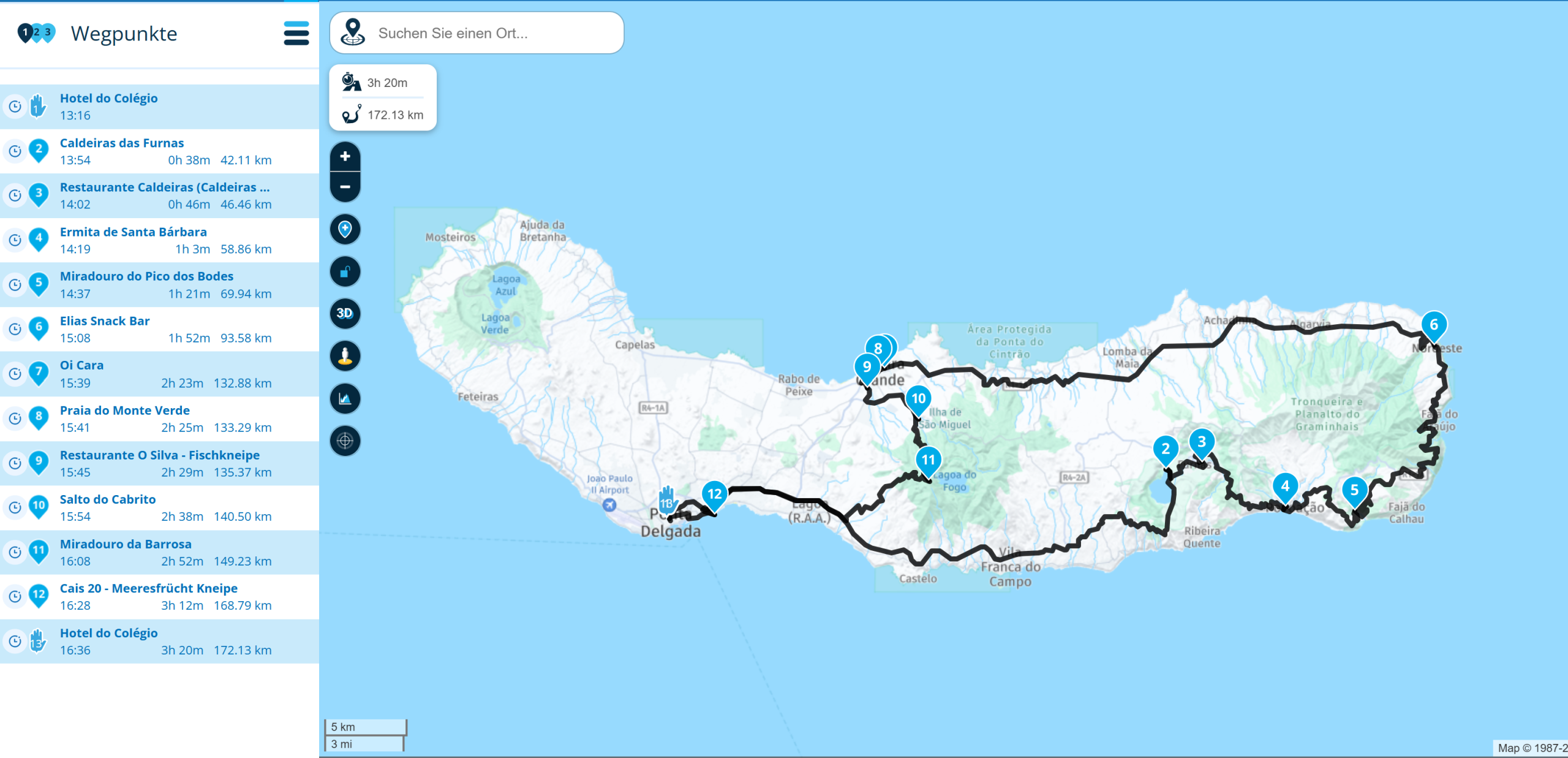
Circular tour from Furnas to the east coast and back via the north-east coast
- Hotel do Colégio
- Caldeiras das Furnas
- Restaurante Caldeiras (Caldeiras e Vulcões) – traditional cooking in earth pits
- Miradouro do Pico dos Bodes
- Elias Snack Bar – at the eastern tip of the island
- Oi Cara – pub
- Praia do Monte Verde
- Restaurante O Silva – fish pub
- Salto do Cabrito
- Barrosa Viewpoint
- Cais 20 – seafood pub – recommended
- Hotel do Colégio
Friday, 21 May 2027
Flight to Pico
Return hire car at the airport by 07:00
Flight Booking Code: YFLSTW
Departure from: Ponta Delgada (PDL) – Date: 21 May 2027 – Time: 08:05
Flight number: SP 436 – Operated by: SATA AIR ACORES
Total journey time: 0h 55m
Arrival at: PICO ISLAND/PT São Roque (PIX) – Date: 21 May 2027 – Time: 09:00
Georg: 8D, Volker: 7A, Gerald: 6A, Kurt: 7D
Taxi to the hotel
Overnight stay / Check-in at:
Hotel Madalena Caravelas, Rua Conselheiro Terra Pinheiro, 3, Madalena, 9950-329
Telephone: +351 292 628 550
two double or twin rooms including breakfast
Car hire collection next to the hotel
booked via Check24.de – booking number 16340497 – Hyundai Kauai or similar – local rental company is ‘Ilha Verde’ –
Duration from 21 May 2027, 10:00, to 24 May 2027, 09:00
Activities after arrival:
possibly a light brunch after checking in
Exploring Madalena, a stroll along the promenade, then a visit to A Cooperativa = winery with tasting OR a drive to the
Cella Bar, Rua Da Barca, Carmo, 9950-303 Madalena, Portugal
also by car: visit to the vineyards (Criação Velha, a UNESCO World Heritage Site since 2004), there: Café Costa, Estraga Terro
OPTION: Dinner at the AZORES WINE COMPANY. Menu available at:
https://www.antoniomacanita.com/en/wineries/azores-wine-company/wine-tourism-azores/restaurant-latitude – please have a think about it and let us know if you’d like to book!
Saturday, 22 May 2027
Whale watching
Morning tour: Meeting time 0820
Starting with a briefing of around 20 minutes, followed by three hours on a RIB boat
Contact:
Roxane Rambert – CetaceanWatching Lda – 9950-305 Cais da Madalena
Mobile: +351 926 919 645 – https://cwazores.com – requests@cwazores.com
In the afternoon
I’m planning to start off by relaxing by the pool or in a pub
and perhaps in the evening: chilling out at the harbour, beer & petiscos
 Sunday, 23 May 2027
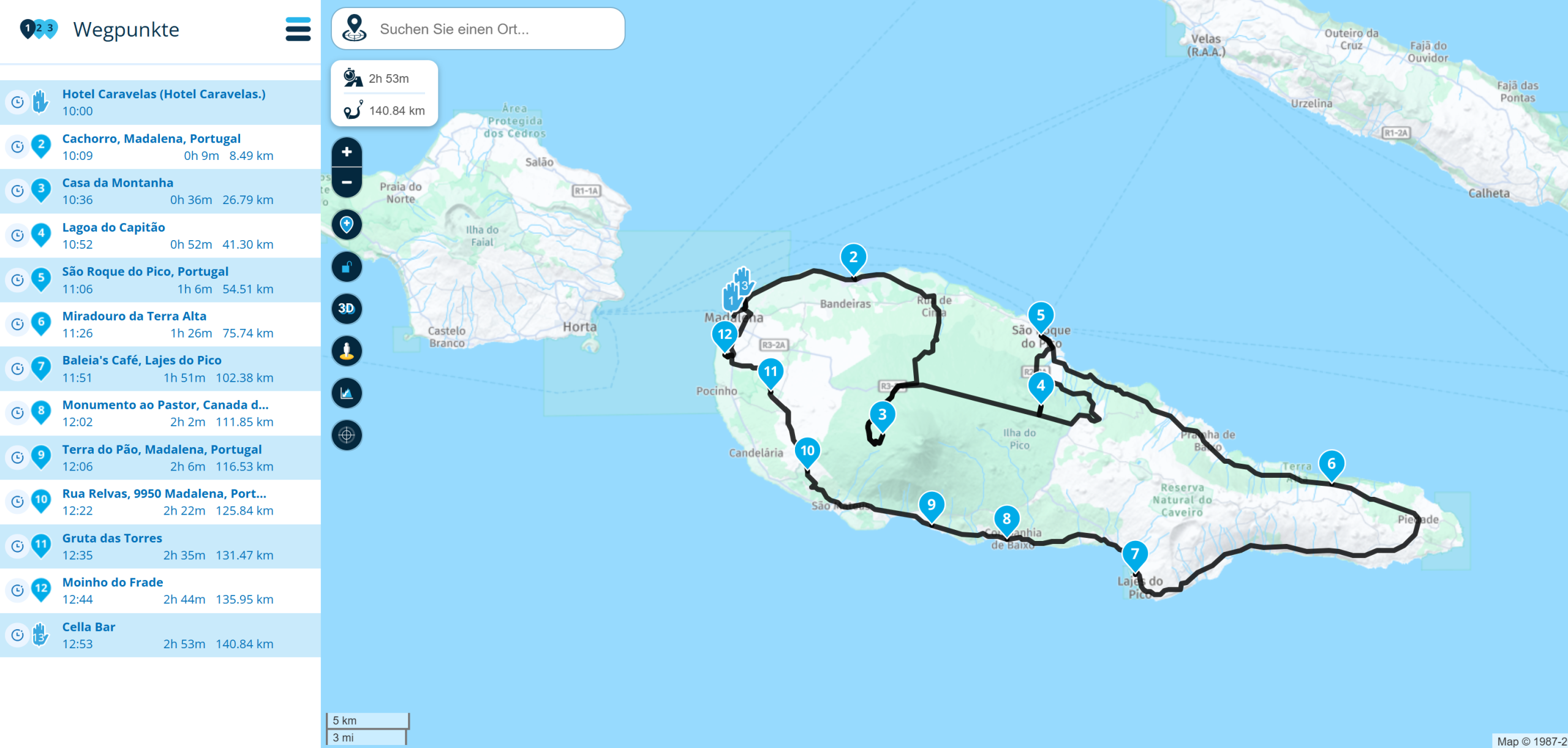
Tour of Pico
SUGGESTION:
- North coast near Cachorro – spectacular stretch of lava coastline, natural rock tunnel – lava coast – surf – beautiful photo opportunities
- Pico Volcano – stops at the Casa da Montanha visitor centre
Photo opportunities already along the road - Lagoa do Capitão via the central plateau.
The lake lies in the middle of the highlands and, in good weather, offers the classic Pico postcard view - São Roque do Pico – perhaps lunch here
- Miradouro da Terra Alta
- Lajes do Pico – reportedly the most beautiful spot on the south coast; pop into Baleia’s Café at the harbour for a drink of some sort; there’s also a whaling museum here
- Gruta das Torres – lava tube with a guided tour, if it’s not too late
- Moinho do Frade historic windmill
- A nightcap at the Cella BAR, Lugar Da Barca, Madalena, Pico 9950-303 Portugal
- In the evening
perhaps head to “O Cinco” at Rua Carlos Dabney 5 in Madalena – +351 292 623 970;
The spinach.guide writes: “Caffe 5 is a cosy restaurant serving regional home-style cooking” … “Although the focus is mainly on meat dishes,” … “The portions are generous, the staff are friendly” …
– Alternatively: Restaurante Atmosfera – Rua dos Biscoitos 34, Sete Cidades, 9950-333 Ilha do Pico, Portugal – or pubs at the harbour
Monday, 24 May
Ferry to VELAS – Ilha São Jorge
Hire car Return by 09:00
- Ferry – not yet bookable
Departure from Madalena (Pico) → Velas (São Jorge)
Usual departure at around 11:00, journey time approximately 2 hours - Hired car collection, booked via check24 – local hire company Autatlantis – +351295432800
Porto Marítimo Velas, Velas, booking number: 59274231
Pick-up/drop-off dates: Mon, 24 May 2027 at 12:00 until Wed, 26 May 2027 at 11:45 - Accommodation / Check-in at
HOTEL SAO JORGE GARDEN - Activities:
Short walk/exploration: viewpoints, cheese tasting (São Jorge cheese);
Harbour bars in Velas (quiet, local).
 Tuesday, 25 May
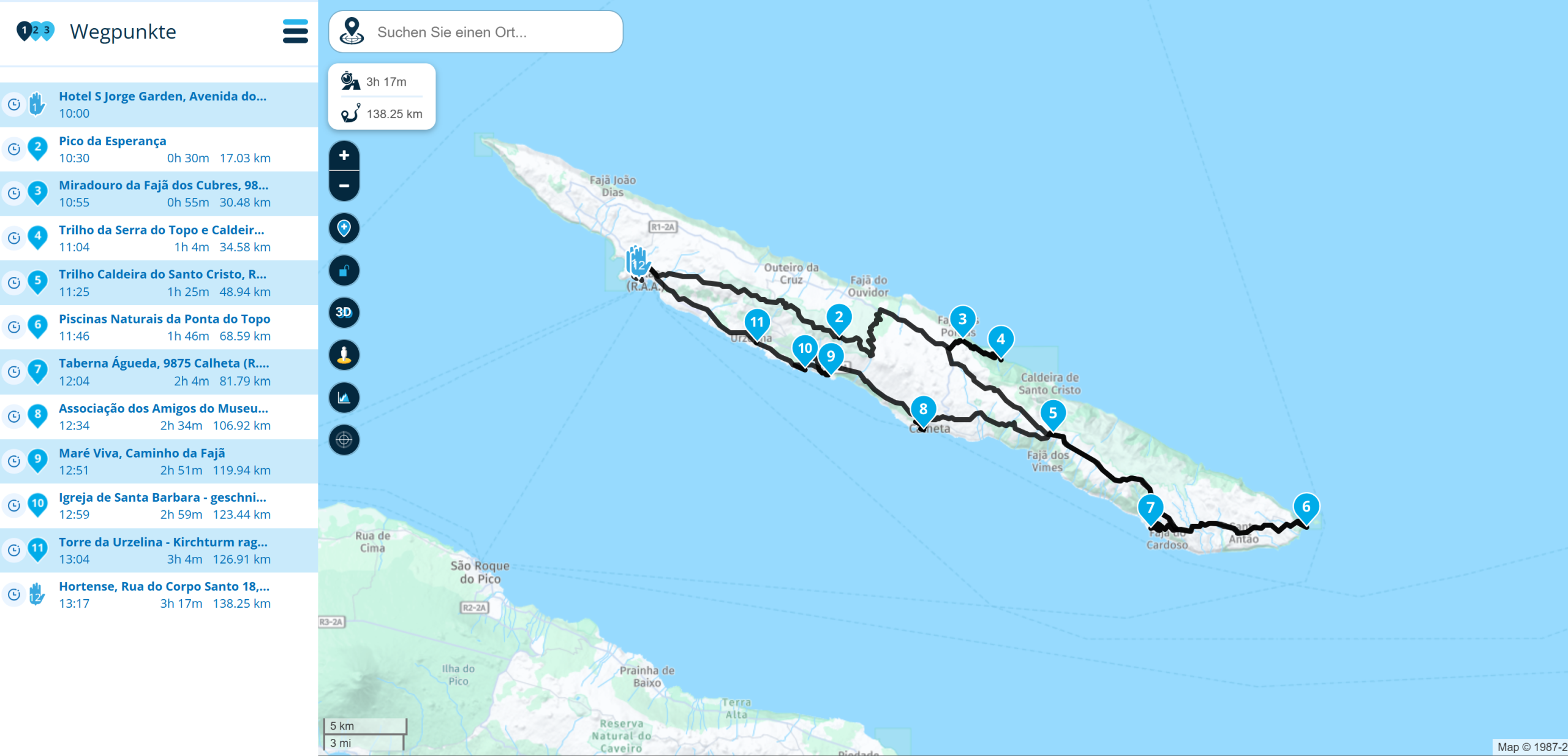
Circular tour of Ilha Sao Jorge
SUGGESTION:
- Hotel S Jorge Garden, Avenida dos Baleeiros
- Pico da Esperança
- Miradouro da Fajã dos Cubres
- Skip this as it is a dead end:
Trilho da Serra do Topo e Caldeira do Santo Cristo - Viewpoint at the junction of the Trilho Caldeira do Santo Cristo trail
- Option to drive all the way to the eastern tip of the island:
Piscinas Naturais da Ponta do Topo - Taberna Águeda
- Associação dos Amigos do Museu de São Jorge
- Option to drive all the way to the eastern tip of the island:
- Maré Viva, Caminho da Fajã – café
- Igreja de Santa Barbara – carved cedar ceiling well worth seeing
- Torre da Urzelina – the church was destroyed in 1808; the tower still rises from the lava
- Nightcap: 12 Hortense, Rua do Corpo Santo 18, Velas
Evening:
We’ll see 😊 Harbour bars in Velas (quiet, local).
Wednesday, 26 May
- Ferry to Horta – Faial Island
- Hire car return
also at the harbour by 11.45 am at Autatlantis - Ferry – not yet bookable
Departure from Velas (São Jorge) to Horta (Faial)
Usual departure at around 09:00, journey time approximately 2 hours - Car hire Collection, booked directly with autatlantis
Reservation Number: 403705
Group Group D
Pick-up (Faial) Horta Harbour – 26 May 2027, 11.30 am
Drop-off (Faial) Horta Airport HOR – 28 May 2027, 11.30 am - Accommodation / Check-in at
HOTEL AZORIS FAIAL GARDEN – R. Cônsul Dabney, 9901-856 Horta, Portugal
2 Executive Rooms with Ocean View, breakfast included - Activities:
Peter Café Sport – legendary amongst sailors, a must-visit as this is where almost all Atlantic crossings by ‘private’ sailors set off from
Bars around the harbour – ideal for beer, rum and gin - Dinner:
Recommendation: Taberna Azevedo (Pedro Miguel): a rustic, authentic village pub and tavern away from the tourist crowds; hostess Marlene serves traditional, hearty Azorean stews (Alcatra) and fresh octopus. Be sure to book 48 hours in advance on +351968315208
 Thursday, 27 May
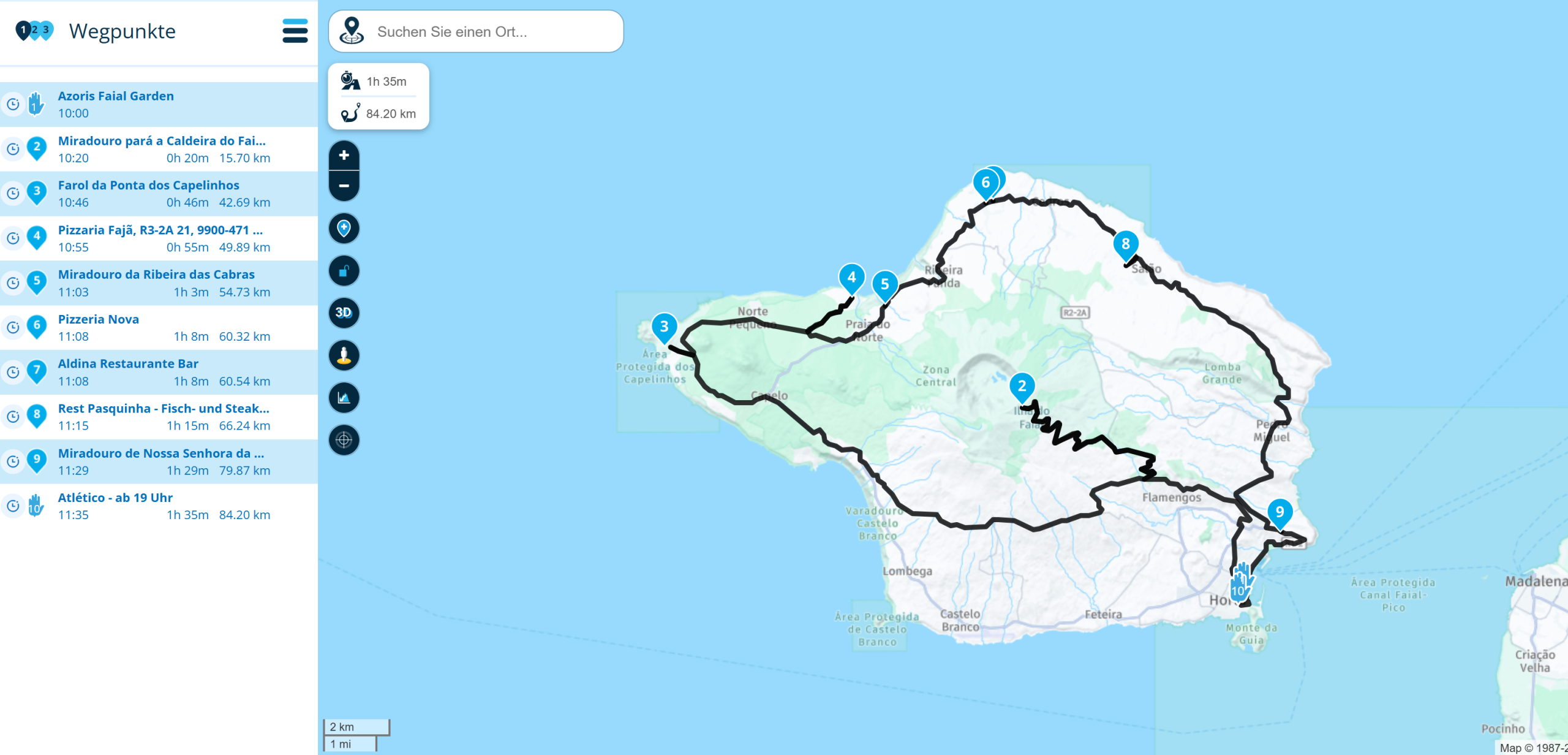
Tour of Ilha Faial
SUGGESTION:
- Miradouro para a Caldeira do Faial
- Farol da Ponta dos Capelinhos
- Pizzaria Fajã, or at least have a look at the Fajã
- Miradouro da Ribeira das Cabras – the Fajã again from above
- Pizzeria Nova – option 1 for a bite to eat
- Aldina Restaurante Bar – option 2 for a bite to eat
- Restaurante Pasquinha – fish and steak dishes – apparently it’s absolutely brilliant!
- Miradouro de Nossa Senhora da Conceição
… and then have a bit of a relax, perhaps by the pool?
- Dinner:
Restaurante Atletico, R. Filipe Carvalho, R. das Angústias S/N, 9900-052 Horta, Portugal
Among other things, they serve grilled octopus here!
Friday, 28 May
- Flight to Ponta Delgada – Ilha São Miguel
- Return of hire car at the airport by 11.30 am
- Departure from: HORTA (HOR) – Date: 28 May 2027 – Time: 12:30
Flight number SP 571 – Operated by: SATA AIR ACORES
Total journey time: 0h 55m
Arrival in: Ponta Delgada (PDL) – Date: 28 May 2027 – Time: 13:25 - Taxi to the hotel
- Overnight stay at:
Mercure Ponta Delgada Azores – Rua Machado dos Santos 82 – 9500-083 PONTA DELGADA
hb366@accor.com – +351 296102424 – BOOKING NO. QQPPCXXM
2 rooms with breakfast
The hotel has indoor and outdoor swimming pools, as well as tables and chairs for sheep’s heads 😊
Saturday, 29 May
- Taxi to the airport
- RETURN JOURNEY Booking reference: 7TRA3D
Departure from: Ponta Delgada (PDL) – Date: 29 May 2027 – Time: 13:45
Flight number: LH 1549 – Operated by: Lufthansa
Total journey time: 4h 40m
Arrival at: Frankfurt International (FRA) – Date: 29 May 2027 – Time: 20:25
1 stopover at Frankfurt International: 1h 50m
Departure From: Frankfurt International (FRA) – Date: 29 May 2027 – Time: 22:15
Flight number: LH 148 – Operated by: Lufthansa
Total journey time: 0h 45m
Arrival At: Nämbärch (NUE) – Date: 29 May 2027 – Time: 23:00
Well, that’s it for now! Hopefully the journey won’t take as long as it took me to plan it 😊! Because no teacher in the world has that much time!
Information on the islands visited
Sao Miguel
… at 65 km long and 16 km wide, it is the largest, most populous and best-developed island in the Azores for tourism. Hardly any visit to the Azores bypasses the ‘Ilha Verde’. There are wonderful beaches, historic neighbourhoods and plenty of opportunities for extensive hiking – though that’s probably not so important for us ‘foot-sore’ travellers 😊.
When the island was first settled in 1444, large parts of it were still covered in dense forests. Parts of these were later cleared to make way for sugar cane plantations. The wood was also welcome for building houses and as fuel.
Maize and pulses are grown, as are tobacco and wine. And there’s one more fruit that’s an integral part of São Miguel: the pineapple.
In the north-east, excellent tea is cultivated on Europe’s only tea plantations, whilst cows graze in the highlands. Nevertheless, there’s also a proper industrial sector on São Miguel. The businesses are clustered around the centres of Ponta Delgada and Lagoa, where around a third of the island’s population lives. Here there are breweries, tobacco processing plants, canning factories and a cement works.
No visit to the Azores is complete without a stop at the largest town, Ponta Delgada. The capital has an important harbour and is undoubtedly the economic centre. The 16th-century harbour fortress
still stands today. Also worth visiting are the Igreja de São José and the Igreja Matriz de São Sebastião, as well as the 17th-century Conceição Palace.
A stroll through the old town is well worth it and takes you along a sea of black-and-white cobbled pavements. Cafés and restaurants can be found along the extensive waterfront promenade. Ponta Delgada is also home to the University of the Azores, with its Faculty of Arts and Social Sciences and more than a thousand students.
In fact, São Miguel once consisted of two parts. In the west, the Sete Cidades volcano once rose well over 1,000 metres, and the Caldeira das Sete Cidades can still be seen today. Alongside this, the romantic highlands are home to many idyllic crater lakes in shimmering shades of blue and green. To the east lie the Serra de Água de Pau, featuring the 947-metre-high Pico da Barrosa, and the Serra da Tronqueira. This area, which includes the 1,103-metre-high Pico da Vara, is also the oldest mountain range, dating back three to four million years.
It was only around 50,000 years ago that a land bridge formed between the two massifs. Today, around 65 volcanic cones are strung out here, all of them only about 5,000 years old. This region is largely flat and is therefore the most densely populated today. The last major eruption took place in 1652, when Pico do Fogo near Lagoa erupted. The region around this idyllic crater lake is still active today, and numerous minor earthquakes occur every year.
Alongside the magnificent beaches, there are also steep, towering cliffs. Inland, however, the landscape is far less organised; here, nature still reigns supreme. Away from the pastures, a primeval forest stretches up the slopes to the crater around Sete Cidades in the west of the island. The two lakes lie below, one blue and the other turquoise-green. The giant crater is an astonishing natural wonder.
Its rim stands a good 500 metres high and can be circumnavigated on a longer hike. Countless legends surround the Caldeira.
In the charming little town of Furnas, with its 22 hot springs, you can bathe in sulphurous springs and volcanic-heated streams. Jesuit priests discovered the healing properties of this romantic valley, and so Furnas developed into a spa resort. Giant ferns, laurel and eucalyptus trees, as well as wild ginger, grow in the valley. The springs and mud are used for therapeutic purposes at the thermal spa. Palaces and parks bear witness to the island’s former wealth, including the Parque Terra Nostra with its outdoor thermal lake.
The fishing village of Povocao is home to the oldest place of worship, the Capela de Santa Barbara. It was here that the island’s first settlers made their home.
The former capital, Vila Franca do Campo, was destroyed by an earthquake in 1522. Today, Vila Franca is a friendly place from which you can take a boat trip to swim in an extinct volcanic crater on the nearby Ilhéu de Vila Franca.
Pico
With over 100 volcanoes, Pico is known as the ‘Ilha Montanha’ (Mountain Island) or the ‘Ilha Negra’ (Black Island). Covering 448 km², it is the second-largest island in the Azores and is famous for its smooth wine, jet-black rock and abundant whale sightings.
On this island, which is largely surrounded by cliffs, the western half is home to the mountain of the same name, Pico, which stands at 2,351 m with its steep flanks; incidentally, it is Portugal’s highest peak and the third-highest summit in the Atlantic. To the east of this, there is nothing but wilderness and pastureland. A mountain road leads from Madalena up to the Pico massif and crosses the island to its eastern tip at Piedade. Clouds often hang over the highlands, and unfortunately there’s no visibility. We’ll see 😊!
At an estimated 300,000 years old, Pico is the youngest of the Azores islands. The sulphurous fumes rising from the fumaroles at the summit show that the volcano is still active.
Pico was first settled in 1460. The orchards and vineyards required – and still require – a great deal of work. Initially, wheat, pastell and grapes were cultivated, followed later by oranges. After volcanic eruptions devastated the fields and mildew and grapevine aphids destroyed the orange groves and vines in the 18th century, the future of agriculture came to rely solely on new, resistant grape varieties or was limited to fishing.
In 1718, Pico last erupted at an altitude of around 1,300 metres. The lava fields created by volcanic eruptions are known as ‘Misterio’ (Mysteries). Today, the mountain lies dormant, but it is still active and under scientific monitoring. However, volcanism has its positive side: the lava was, and still is, a building material for the island’s characteristic black stone houses and walls. The latter protect the vines from the sea breeze.
There are several volcanic caves around Mount Pico, some of which extend deep into the mountain. The Azores’ longest lava tube is also located on the island. Part of the Gruta das Torres near Criacao Velha is now open to tourists. At over 5 km in length, it is one of the longest lava caves in the world and is a regional natural monument. In general, the caves are dangerous and should only be explored with a guide.
The capital is Madalena. However, the town is more of a distinct village with a burgeoning tourist infrastructure. All round the island, there are a number of pretty villages, all of which have their own harbour or access to the sea. You will search in vain for settlements in the island’s interior.
Wine-growing is particularly prevalent in the north and west. Alongside full-bodied red wine, the famous and equally expensive Verdelho is produced. It is particularly well-suited as an aperitif and was once exported as far afield as Russia. Waist-high black ‘currais’ criss-cross the region like a spider’s web. The lava-stone walls provide protection from the wind and also retain heat well into the night.
The island experienced a real boom in the 18th century when there was still a large population of sperm whales. The whalers of Pico were regarded as particularly brave. It is no coincidence that Herman Melville effectively erected a literary monument to them in his novel ‘Moby Dick’.
The whales are still there: today, however, whaling has become a tourist attraction. Over 20 species have been recorded and visit the waters around the island from May through to autumn to feed. It is mainly sperm whales that are regularly spotted here. Let’s see – we’ll find out soon enough whether we catch a glimpse of any!
Sao Jorge
Unlike all the other eight Azores islands, São Jorge resembles a long needle. Although the island is 56 km long, it is barely 8 km wide. However, it rises out of the sea to a height of over 1,000 m in the form of a rugged mountain ridge.
In the highlands, volcanic cones line up one after the other, dropping steeply down to the sea. The views are correspondingly breathtaking. The island is one of the most popular holiday destinations for walkers and truly captivates visitors with its natural beauty.
The island is divided into two districts – Calheta and Velas – which are in turn made up of countless small villages. Together with the two neighbouring islands, Pico and Faial, São Jorge forms the so-called ‘Triangulo’ of the Central Group.
São Jorge is first mentioned in 1439. Five years later, in 1443, there is evidence that the island was inhabited. From 1470 onwards, the first settlements – Topo and Velas – began to emerge. Eventually, the Flemish nobleman Wilhelm van der Hagen arrived on the island and settled in the east, near Topo. He was regarded as a man of standing and went down in the island’s history under the name Guilherme da Silveira. Today, just under 10,000 people live on the island, along with twice as many cows. Dairy products and livestock farming are now the driving force behind the island’s economy, thanks in part to EU subsidies.
In the capital, Velas, a few manor houses still bear witness to a noble past, including a 17th-century church. The island’s main port is also located here.
In Manadas stands the Igreja de Santa Bárbara. With its carved cedar wood ceiling, it is perhaps the most beautiful Baroque church in the Azores.
The church tower in Urzelina is also striking. It still rises today as a remnant from the layer of lava that destroyed the rest of the church, along with the village, during a volcanic eruption in 1808.
Livestock farming and dairy farming are the main sources of income for many families. The bulls are exported to the mainland. The cows’ milk is processed locally. Milk churns can be seen standing outside doors everywhere, and the mule remains an important means of transport to this day. No wonder, then, that the island is still something of a living museum.
The island’s cheese is widely renowned; the salty air and the evergreen high-altitude pastures give it its distinctive flavour. The oldest cheese dairy is the Cooperativa da Beira, founded in 1927.
Traditional handicrafts are also still practised on São Jorge: tapestries and woollen blankets are still woven on old, hand-operated looms, just as they were a hundred years ago. It takes the women two weeks to complete a single tapestry.
The west is sparsely populated and characterised by a multitude of small hills. Here, people still make their living directly from agriculture, and so it is not uncommon even today to come across people with their old ox-drawn carts.
On the northern side, endless rows of hydrangea hedges wind their way along the road and the countless pastures. The few villages here are all situated along the main road at roughly the same altitude. Below the main road, numerous pastures stretch right down to the cliff edge. Above the few fajas that are still inhabited, there are magnificent vantage points in places. In good weather, you can also look out from here towards Graciosa and Terceira.
The southern side, overlooking neighbouring Pico, is more densely populated. Here you’ll also find a few places to swim, although these consist only of natural pools and man-made pools – there’s no sand. However, only the stretch between Velas and Calheta is densely populated.
The seemingly endless south-eastern stretch of São Jorge is almost deserted. Here, you mainly see cows and milk churns. Island life quickly fades away here, and tourists are rarely to be found. At Piquinho da Urze, the wind turbines turn, generating plenty of electricity. Due to its high altitude, the eastern part of the island is often shrouded in mist.
The coast of São Jorge is mostly steep and characterised by numerous fajas. These are small, extremely fertile coastal plains right down by the sea. Following the 1980 earthquake, most of the 75 fajas were abandoned, and only those that are safe and easily accessible are still inhabited.
They were formed by solidified lava flows on their way to the sea and by a series of landslides caused by the recurring earthquakes. The soil is therefore extremely fertile.
Soon after the island was settled in the 15th century, these headlands were cultivated. And even today, many people live in some of the most remote places, putting up with the often arduous journey on foot. Particularly in summer, one still comes across farmers in their small huts, far removed from civilisation.
Indeed, many villages lie at the foot of the sheer cliffs. Some of these remote settlements are still inhabited and can only be reached via zigzagging paths winding around the green cliffs, adorned with waterfalls.
Every evening, the area becomes noisy: after dusk, the cries of the cagarros echo across Velas Bay and the other cliffs. The yellow-billed shearwaters (Calonectris diomedea) have an unmistakable call as they fly over the cliffs.
Faial
…is one of the five islands in the Central Group of the Azores. It is also known as the ‘Blue Island’ – Ilha Azul – due to its abundance of blue hydrangeas.
Around 15,000 people now live on the almost pentagonal island of Faial. The capital is Horta, a charming town steeped in history, which still has much to offer architecturally with its stately buildings and is rightly considered one of the most beautiful towns in the Azores.
A visit to the island of Faial is a must, especially for sailors. Horta is the quintessential stopover for those crossing the Atlantic. Every year, over 1,700 sailors and cruisers stop off here at the international marina, lending the island an international flair. People then gather at the famous Peter Café Sport, the most famous bar in the Atlantic.
This vibrant atmosphere characterises not only Horta, but life on the whole island. Faial therefore has its own special charm. Incidentally, the island owes its name to the endemic myrica faya, a myrtle bush that can grow up to 20 metres tall.
Faial has always been open to new ideas from all over the world. As early as the 15th century, the first foreigners arrived on the island in the form of Josse van Huerters’ compatriots from Flanders. The Flemings were searching for precious metals – without success – and eventually stayed because of the fertility of the land. Incidentally, one of his daughters married Martin Behaim from Nuremberg, who also lived in Horta for several years and was knighted by the Kingdom of Portugal.
In the 18th century, new foreigners arrived: American whalers restocked their provisions in the harbour of Horta and recruited brave young men for their ships. The United States responded by sending a consul to the island specifically for this purpose: John Dabney from Boston. Hardly anyone shaped the island’s industrial boom as much as he did. He created numerous new jobs in his factories.
The turn of the 19th to the 20th century brought Faial – and Horta in particular – back into the headlines. The telegraph cables across the Atlantic ran via Horta. There were relay stations and signal amplifiers here. The town became the world’s new hub, and all the major telegraph companies had a base here.
Although modern technology has deprived Faial of the basis of its prosperity, the islanders have adapted skilfully. It is now the political and cultural centre of the Azores.
To the west lies a chain of smaller volcanic cones, ending at Vulcão dos Capelinhos. This natural monument was the site of massive eruptions in 1957–58. For weeks, the earth trembled at Ponta dos Capelinhos. Columns of ash soared four kilometres into the sky. The volcano spewed lava for a whole year.
Since then, only the first storey of the lighthouse has remained visible. The island has grown by 2.4 km² as a result.
The island has been in a state of constant turmoil for centuries. As early as 1672, the Cabeco do Fogo in the north-west erupted, wiping out numerous families. However, the slopes were soon overgrown again. Today, the forest on its flanks is so dense that it is difficult to make one’s way through it.
Hardly anyone lives in the highlands. Large parts of them are still densely overgrown. The east slopes gently down towards the coast. The coastline is characterised by steep rocky sections and small sandy coves. There are several lovely beaches for swimming. Most are located around the capital, Horta, at Porto Pim and Praia do Almoxarife. Another is situated in the bay of Praia do Norte. In addition, there are a number of natural swimming pools and rocky coves.
The villages on Faial are mostly simple linear settlements stretching along the EN1 ring road. However, one should not be surprised to see ruins and facades riddled with cracks in most of these villages: in 1998, a severe earthquake destroyed several villages, and even today the island has not fully recovered from the aftermath. Many people were left homeless by the quake. Entire settlements collapsed. Even today, some families still live in the temporary accommodation containers set up at the time, and repairs to the damaged buildings are progressing only slowly.
Flashes of red light keep appearing from the hilly landscape: just as on Graciosa, you’ll still come across the odd windmill on Faial. Most of those still in good condition are situated on the Espalamaca ridge. From the Miradouro de Nossa Senhora da Conceição on the Espalamaca hill, you also have a wonderful view over the town in the wide bay.
Bar recommendations on Faial:
- Taberna Azevedo (Pedro Miguel): a rustic, authentic village pub and tavern away from the tourist crowds; the hostess, Marlene, serves traditional, hearty Azorean stews (Alcatra) and fresh octopus. Be sure to book 48 hours in advance!
- Pasquinha (Salão): This restaurant is situated in the north of the island on an elevated hillside (Canada do Monte). The ‘wow factor’ here is the magnificent, elevated view over the rugged landscape and the Atlantic Ocean. They serve huge, hearty portions of local cuisine (such as excellent fish and steak dishes).